
A River-First Approach
The Strategic Masterplan provides a long-term, river-first framework for future investment and regeneration along the Clyde. It translates the original Clyde Mission ambition to “make the Clyde an engine of sustainable and inclusive growth” into a spatial and investment framework covering strategic themes, priority programmes and locations across the corridor.
Together with the Strategic Outline Case, the Masterplan provides a basis for prioritising opportunities, developing investment propositions and coordinating activity across authorities, sectors and funding streams. It is intended to support a more coordinated approach to identifying, developing and aligning investment opportunities across the corridor.
About the Masterplan
Development of the Masterplan highlighted how the Clyde can still act as a physical and psychological barrier, with communities separated from the river by infrastructure, inaccessible land and fragmented waterfronts.
The Masterplan deliberately changes that perspective. It treats the Clyde as a strategic spine rather than a boundary, looking at how people and places can be better connected to, along and across the river, while safeguarding strategically important riverfront locations for activities that genuinely benefit from a river setting.
This river-first approach links economic opportunity with improved access, environmental quality, heritage, tourism, wellbeing and placemaking, helping ensure that future investment strengthens the relationship between communities and the Clyde.
The Masterplan recognises that not every issue affecting the Clyde requires a new corridor-wide programme. Instead, it focuses Clyde Mission activity where the river creates a distinctive advantage and where coordinated action across boundaries can add value, while working with existing partners and delivery mechanisms in areas where responsibilities are already established.
Outcomes
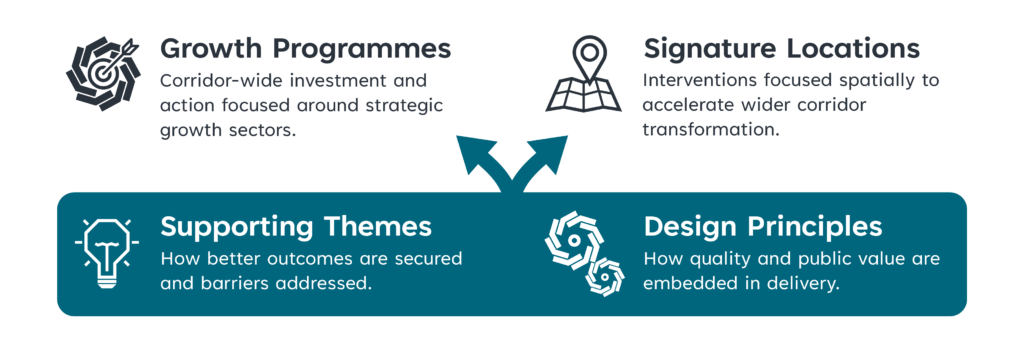
The Masterplan sets out eight interconnected strategic themes. Three lead themes form Clyde Mission’s growth programmes, where a corridor-wide approach can add particular value:
- Culture, Leisure and Tourism
- Maritime and River-Based Economy
- Clean, Affordable Energy
Together, these provide the strongest opportunities to use the Clyde as an engine of sustainable and inclusive growth, supporting investment, jobs and skills and contributing to longer-term economic resilience.
The five supporting themes are Connectivity; River and Land Remediation; Flooding and Climate Resilience; Green and Blue Infrastructure; and Liveable Communities. These help unlock opportunities, address barriers and support better economic, environmental and community outcomes across the growth programmes and Strategic Locations.
Alongside the strategic themes, the Masterplan identifies Strategic Locations where coordinated investment and intervention can deliver wider benefits across the corridor. These provide a spatial focus for clustering and packaging opportunities, addressing common barriers, de-risking investment and accelerating development. Initial prioritisation focuses on the most deliverable opportunities under current conditions, with periodic review allowing priorities to evolve. Clyde Mission will coordinate and add value where a corridor-wide approach is beneficial, without replacing partner-led delivery.
Development: The Journey
In December 2025, Glasgow City Region appointed AtkinsRéalis, supported by Kevin Murray Associates and Austin-Smith:Lord, to develop the Masterplan. The work has been overseen by a Short-Term Working Group, providing partner input and oversight throughout the development of the Masterplan. The Masterplan has been informed by a programme of evidence-gathering, stakeholder engagement, field studies and public consultation. Stage 1 engagement brought together almost 400 participants through an online launch event, thematic workshops, field studies, one-to-one engagement and other feedback.
The Stage 1 Engagement Summary Report provides an overview of the engagement undertaken and the key themes and priorities identified.
In June 2026, a public consultation was launched to provide the opportunity for members of the public to input ideas, suggestions and provide views on the initial priorities of the Masterplan. The consultation received almost 450 responses. Feedback highlighted support for improving connections to the river, celebrating its heritage and culture, supporting economic opportunity, improving environmental quality, and providing greater clarity on delivery and outcomes. The emerging framework was refined in response to this feedback and following stakeholder discussions.
This feedback has helped shape the emerging framework, including the stronger river-first approach, clearer growth priorities and greater emphasis on investment development, readiness and measurable outcomes. The Strategic Masterplan outcomes and strategic direction will be considered through the Glasgow City Region governance in November 2026.
Detailed proposals and location-specific content are continuing to be reviewed with relevant officers across the partner local authorities to ensure that the final material accurately reflects local circumstances, priorities and delivery considerations.
The Clyde Mission Strategic Masterplan was approved by Cabinet on 17th November. The next phase will focus on delivery development and investment engagements. This will include further feasibility and evidence work, business-case development, investment packaging, funding bids and structured engagement with partners, funders and investors. An official launch is also proposed to mark this transition, with delivery remaining principally with the organisations holding the relevant powers, assets, responsibilities and resources.